Introduction
In a landscape where employee benefits are a key factor in attracting and retaining talent, benefits consulting firms play a critical role in shaping not just what employers offer, but how those offerings are evaluated and evolved
over time.
This white paper explores the strategic partnership potential between benefits consulting firms and Pietential—a science-backed platform that benchmarks, monitors, and improves holistic employee wellbeing. Pietential can support consulting firms in three key ways:
- As a strategic tool: a platform your firm can use to assess and optimize client benefit programs and employee outcomes.
- As a differentiator: a built-in wellbeing benefit that sets your firm apart and strengthens client relationships.
- As a point solution: a best-in-class offering you can recommend to clients when wellbeing insights are central to their strategy.
In all cases, Pietential enhances the firm’s ability to deliver measurable value to clients—while reinforcing your firm’s position as a forward-thinking advisor in the evolving HR and benefits landscape.

The Evolving Landscape of Employee Benefits
It’s no secret that employees today expect more from their benefits packages. Beyond health insurance and retirement plans, they’re looking for meaningful support across mental, emotional, and personal development domains. According to a recent MetLife study, 81% of employees say they are more loyal to employers who offer benefits that support their holistic wellbeing, and nearly as many actively seek out companies that demonstrate a commitment to total wellbeing as part of their culture—not just their compensation.
But while employee expectations have evolved, employer strategies have often lagged behind. The market is saturated with innovative point solutions—apps, platforms, and programs that claim to improve some aspect of wellbeing. Yet employers face increasing pressure to justify the ROI of these offerings, especially in an era of budget scrutiny and competing priorities.
What’s emerging now is a shift from piecemeal benefits delivery to the creation of a true culture of wellbeing—one that’s measurable, consistent, and aligned with organizational goals. To do that, employers are turning to their benefits consultants not just to recommend vendors, but to help evaluate, benchmark, and track the impact of their overall wellbeing strategy.
This is where Pietential offers unique value. Rather than being one more point solution, it functions as a measurement and insight layer—one that helps consultants and employers alike understand what’s working, what’s not, and where investments in employee wellbeing are truly moving the needle.
Pietential: A Comprehensive Wellbeing Solution
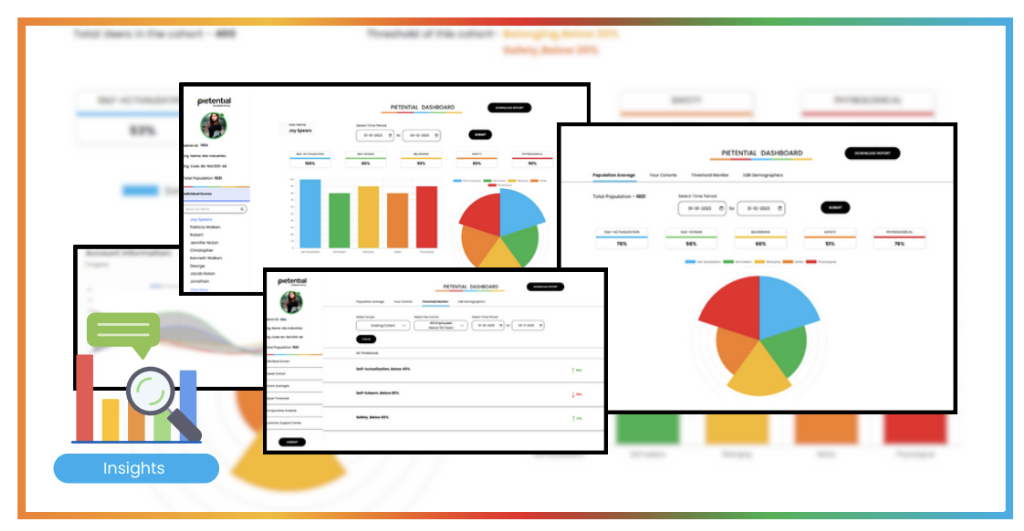
Pietential stands out with its ability to assess, track, and improve the wellbeing of individuals and organizations. By leveraging data analytics and user-friendly interfaces, Pietential provides actionable insights into wellbeing trends, enabling tailored interventions and continuous improvement in employee health and satisfaction.
Benefits of a Partnership for Insurance Benefits Consulting Companies
1. Expanding Benefit Portfolios
- Innovative Offerings: Including Pietential in benefit packages allows consulting companies to offer cutting-edge, data-driven wellbeing solutions, distinguishing their portfolios from competitors.
- Comprehensive Wellbeing Coverage: Pietential’s focus on holistic wellbeing complements traditional health and insurance benefits, offering a more rounded package.
2. Enhanced Value Proposition for Clients
- Meeting Client Needs: By offering Pietential, consulting companies can better meet the diverse and evolving wellbeing needs of their clients’ workforces.
- Customizable Solutions: Pietential’s flexibility allows for customization to fit the unique needs of different organizations, enhancing the consulting firm’s ability to tailor benefit packages.
3. Enabling Data-Driven Strategy and ROI Demonstration
- Objective Wellbeing Analytics: Pietential equips consulting firms with real-time, cohort-level data on holistic wellbeing—grounded in a psychometrically validated model. These insights allow consultants to deliver more precise, data-backed recommendations that evolve as employee needs change.
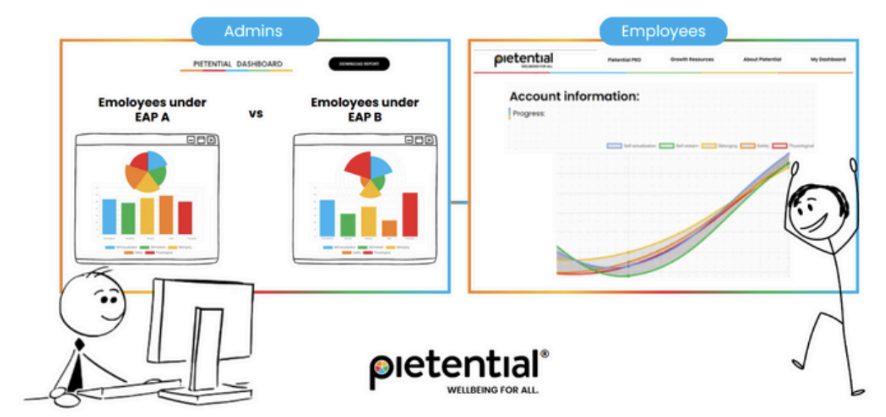
- Cross-Program Evaluation: Pietential doesn’t just show you how users feel—it shows you which benefits are moving the needle.
- Consultants can compare wellbeing scores across users and non-users of specific benefits (like EAPs, coaching programs, or DEI initiatives), providing hard data on what’s delivering value—and what’s not.
- Proving ROI: With Pietential’s measurement and visualization capabilities, consultants can help clients track longitudinal changes in wellbeing, link them to program participation, and demonstrate the return on investment across the entire benefits ecosystem.
4. Deepening Client Relationships Through Insight and Engagement
- Strategic Stickiness: A tool like Pietential deepens your role as a long-term strategic advisor, offering value not only at the point of plan design—but year-round, through monitoring, insight generation, and proactive support.
- Driving Engagement in Benefits: Pietential helps close the gap between benefit availability and benefit usage. By helping employees better understand and act on their own wellbeing data, it increases engagement not just with Pietential, but with the employer’s broader ecosystem of benefits. That’s a win for HR teams —and for the consultants who recommended them.
- Elevating Consultant Differentiation: In a crowded market, your clients want to know that their consultant isn’t just brokering benefits, but evaluating them objectively and optimizing their impact. Pietential gives you that capability—and a defensible advantage over firms still relying on gut feel or vendor claims alone.
Use Cases: How Consultants Can Leverage Pietential
Use Case 1: Supporting Strategic Differentiation in a Competitive Market
A mid-sized benefits consulting firm wants to stand out in a saturated landscape where most competitors offer similar plans and point solutions. Instead of just recommending another vendor, the firm integrates Pietential as part of its strategic planning process with new clients.
They begin by using Pietential to establish a baseline of employee wellbeing across each client’s workforce, revealing patterns in stress, belonging, and motivation that weren’t visible through traditional surveys. These insights allow the consultant to guide the client toward targeted benefits—such as financial coaching, peer recognition programs, or mentorship structures—based on domain-level wellbeing gaps.
Over time, the consultant continues to monitor changes via Pietential’s platform, providing quarterly updates that show how various initiatives are impacting the client’s workforce. This positions the firm not only as a provider of benefit solutions, but as a data-driven advisor delivering ongoing insight. As a result, clients see the firm as a long-term partner—leading to higher retention and referrals.
Use Case 2: Driving ROI Across the Benefits Ecosystem
A national consulting firm supports a client experiencing low engagement with existing benefits and rising stress-related medical claims. The consultant introduces Pietential as a non-invasive, real-time wellbeing measurement tool, integrated into the client’s broader benefits strategy.
Using Pietential’s cohort analytics, the consultant identifies two segments of the workforce with consistently low wellbeing scores—especially in the “Security” and “Esteem” domains. Cross-referencing this data with benefit usage reveals that employees who engage with the EAP or career coaching programs report measurably higher scores.
The consultant uses these findings to help the client:
- Refocus communication strategies to increase engagement with underutilized programs
- Reallocate budget from lower-performing initiatives to more impactful ones
- Track outcomes quarterly, tying usage data back to shifts in overall wellbeing
Pietential becomes the ongoing measurement layer that supports these insights—giving the consultant an objective way to evaluate strategy effectiveness and demonstrate value to HR and Finance stakeholders.
The Future of Benefits Consulting and Wellbeing
The collaboration between insurance benefits consulting companies and Pietential represents a progressive step in employee benefits management. As we move towards a more holistic understanding of employee needs, such partnerships will be crucial in delivering comprehensive, effective, and highly valued employee benefits.
Conclusion
A Consultant’s Competitive Edge in a Saturated Market
Benefits consultants today are navigating a complex, high-pressure landscape: clients expect personalization, ROI, and proof—not promises. Yet most consultants are still being handed spreadsheets, vendor decks, and gut-feel insights when what they really need is something better: a way to objectively evaluate the impact of benefit programs across populations and time.
That’s where Pietential comes in—not as just another point solution, but as an insight infrastructure. It helps you measure what other platforms don’t: the lived experience of wellbeing across your clients’ populations, in real time. It reveals which benefits are making a difference, and which are being ignored or underperforming. And it empowers you to act— backed by data your clients will trust.
In a field crowded with wellness apps and wellbeing vendors, you don’t need another product—you need a strategic advantage. Pietential delivers that by helping you move from benefit recommendation to benefit optimization, and from transactional engagement to long-term, data-driven partnership.
For consulting firms that want to lead—not follow—the evolution of employee wellbeing, integrating Pietential isn’t just an upgrade. It’s a shift in how value is delivered.