Introduction
Diversity, Equity, Inclusion, and Belonging (DEI&B) initiatives have becomeessential for fostering inclusive and innovative workplaces. However, manyorganizations struggle to identify where these programs are most neededand how to prove their effectiveness. Executives often rely on broad metrics like representation, engagement, or turnover to justify DEI&B efforts.

Yet these can fail to capture the root causes of employee dissatisfaction, particularly related to belonging, esteem, and safety. Pietential, a science-backed wellbeing assessment platform, offers DEI&B executives data-driven insights and metrics to help demonstrate the impact, necessity, and urgency of employee-focused programs and policies. By identifying which groups in the workforce are struggling with feelings of exclusion, low self- esteem, or lack of safety, Pietential provides the opportunity for clear and measurable justification for
DEI&B initiatives.
Once these programs are in place,Pietential further supports executives by measuring the impact and efficacy of DEI&B programming, proving efficacy through data and analytics, and gaining a deeper understanding of employee wellbeing over time.
Proving the Need for DEI&B Programs
Often, the first challenge for DEI&B executives is making the case that diversity-related programs and policies are necessary to reduce attrition, create and sustain equitable talent outcomes, and improve overall employee engagement. Organizations may not have a clear picture of which demographic groups feel excluded or marginalized, making it difficult to effectively prioritize resources, because a lack of sense of belonging, a low feeling of safety and security, and other root causes of low wellbeing can show up in any individual or community, and even a total population. So, we measure that. Because the distribution needs to be equitable. Pietential fills this gap by providing a detailed analysis of employee wellbeing across diverse cohorts, offering an evidence-based way to demonstrate where DEI&B
efforts are most needed.

Identifying Gaps in Belonging, Esteem, and Safety
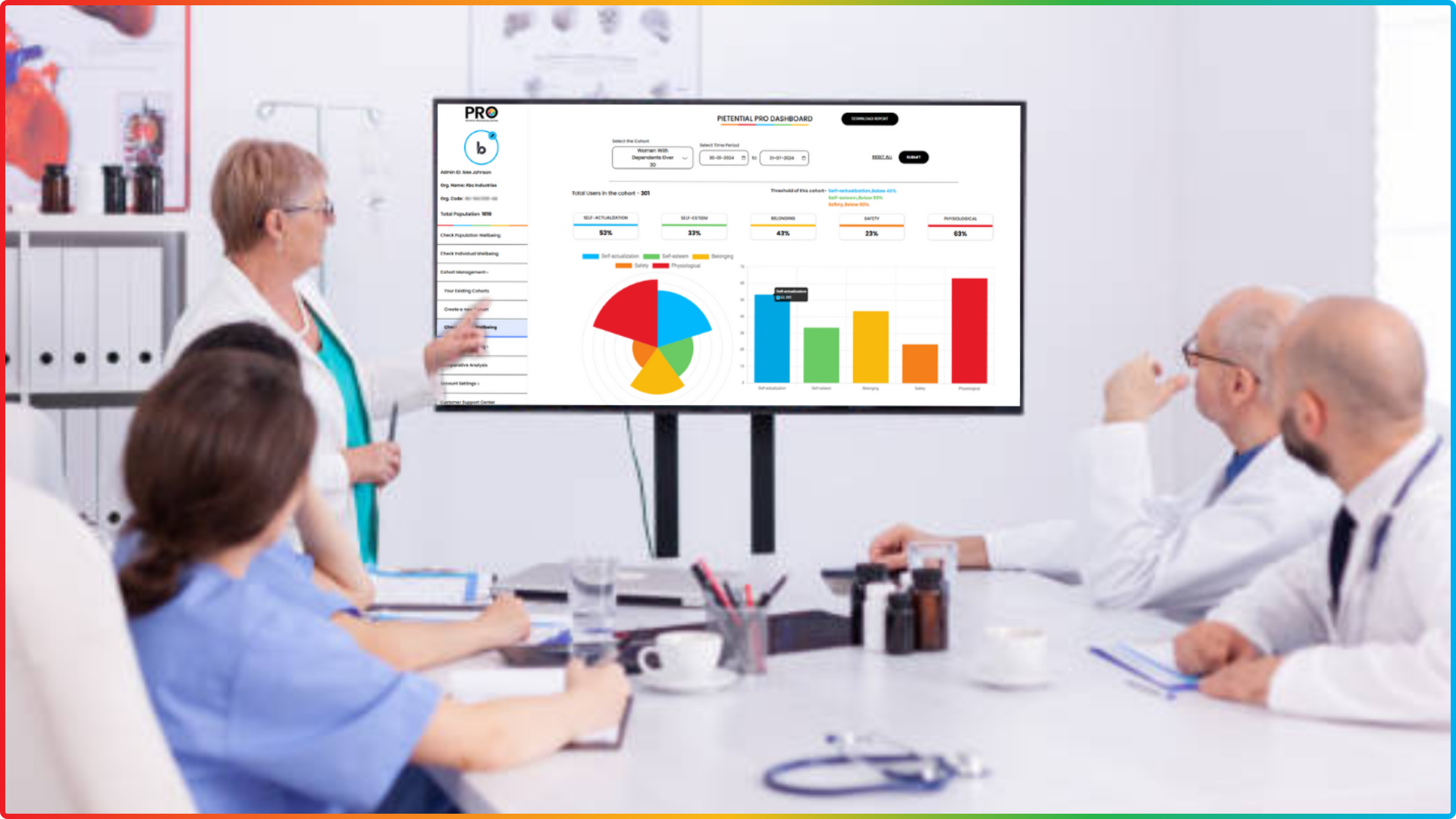
Pietential’s wellbeing assessment is built around Maslow’s Hierarchy of Needs (MHN), including subdomains such as belonging, esteem, and safety. DEI&B programs aim to address issues like workplace exclusion, discrimination, inequity resulting in a comparatively lower sense of belonging. Pietential allows organizations to see which groups are most affected by low belonging, esteem, and safety, giving executives leading indicators and metrics to demonstrate the need for DEI&B initiatives.
For example, suppose an organization finds that women or employees from underrepresented racial or ethnic groups report lower scores in belonging or esteem compared to their predominantly white peers. In that case, the results can signal an immediate need for targeted DEI&B
programs and policies. Pietential’s data-driven insights empower DEI&B leaders to make an objective case for why certain groups need greater support, proving that interventions like mentorship programs, inclusion training, or the creation of more equitable talent process to include headcount and succession planning are necessary to foster a more inclusive workplace.
The message is with the receiver, and Pietential allows organizations to see what message their employees are getting in life and work regarding key areas of their lives. From there, along with other employee performance, engagement, and retention data the organization can support the whole employee.

Demonstrating Wellbeing Disparities Across Demographics
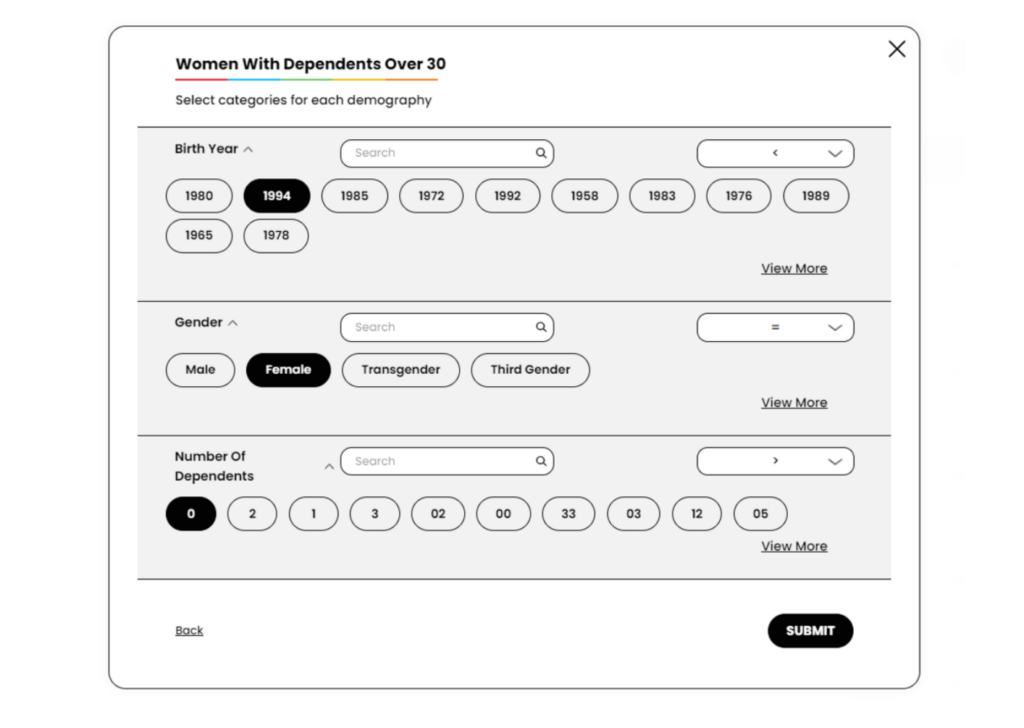
Wellbeing is deeply personal, but systemic inequities often manifest in specific demographic groups. Pietential’s customizable demographic filters allow executives to analyze wellbeing by various criteria such as race, gender, sexual orientation, age, and more. This detailed breakdown can reveal where disparities exist, providing the hard evidence that DEI&B executives need to secure buy-in from leadership for programs aimed at bridging these gaps.
For instance, if LGBTQ+ employees report lower feelings of safety or belonging in comparison to other groups, DEI&B leaders can use this data to justify creating initiatives like inclusive policies, employee resource groups (ERGs), or safe spaces that specifically target the wellbeing challenges these employees face.
Proving the Efficacy of DEI&B Programs
Once the need for DEI&B programs is established and interventions are deployed, the next critical step is proving that these programs are making a measurable impact on targeted employees or staff. This is where Pietential excels. Pietential enables DEI&B executives to track the impact of their initiatives on employee wellbeing over time and across diverse cohorts. By focusing on wellbeing as the foundational metric, Pietential gives DEI&B leaders a deeper and more nuanced understanding of program and policy effectiveness, impact, and outcome success than traditional employee engagement or talent retention metrics alone.
Wellbeing Gap Analysis Across Cohorts
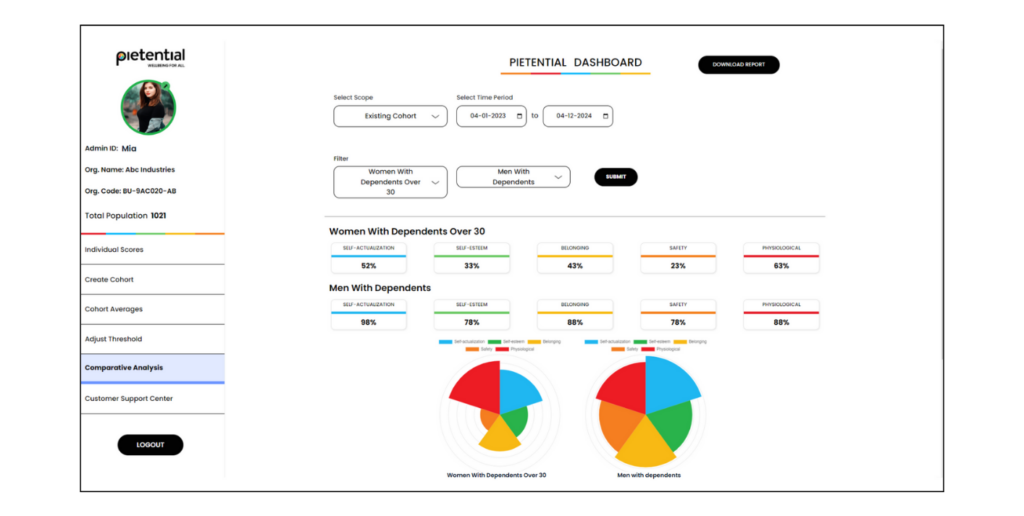
Pietential allows DEI&B executives to track wellbeing across different cohorts over time, offering a comprehensive way to assess the impact of DEI&B programs. For example, if an organization introduces a mentorship program aimed at improving the belonging and esteem of employees from underrepresented groups, Pietential enables leaders to monitor the wellbeing of participants before and after the
program. This wellbeing gap analysis reveals whether the intervention is closing the gaps in belonging and esteem that initially signaled the need for the interventions and countermeasures.
By comparing participants’ wellbeing scores with those of employees who did not engage in the interventions, executives can make adjustments to their DEI&B strategies and quantify program and policy effectiveness using data and analytics provided by the Pietential platform
Longitudinal Tracking for Proactive Adjustments
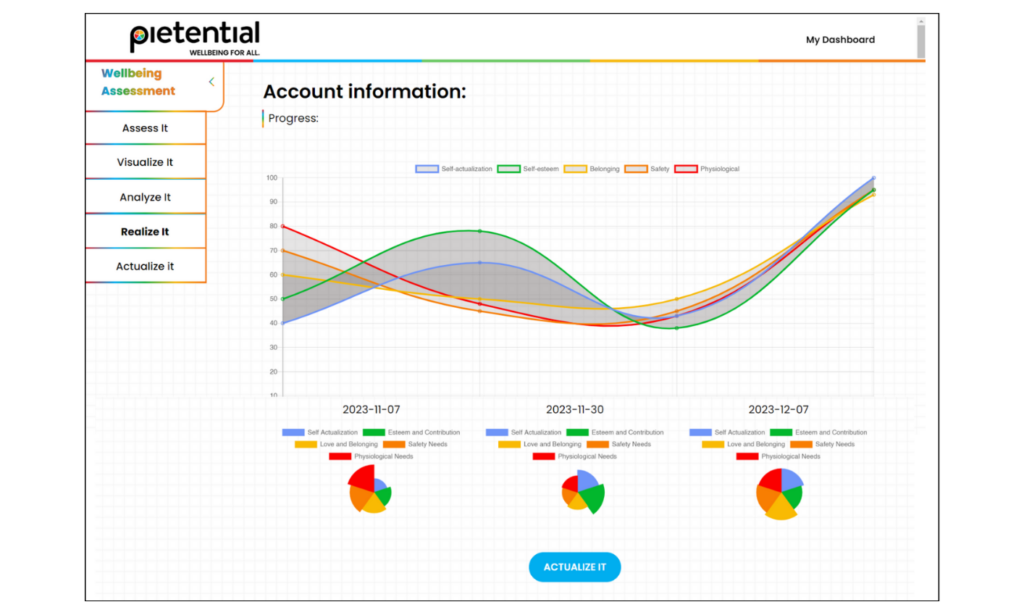
Pietential’s progress tracking feature enables DEI&B executives to conduct longitudinal studies that reveal how employee wellbeing changes over time. This allows for a dynamic approach to DEI&B programming, where initiatives can be adjusted in real time based on their impact on employee wellbeing.
For example, if the wellbeing of a particular group increases, stagnates, or worsens, executives can tweak programs accordingly, ensuring continuous improvement and effectiveness.
DEI&B leaders can also use Pietential’s cohort comparison tools to conduct A/B testing of different program variations, further refining their approach by seeing which initiatives yield the best outcomes for specific groups.
Real-Time Alerts for Critical Wellbeing Dips
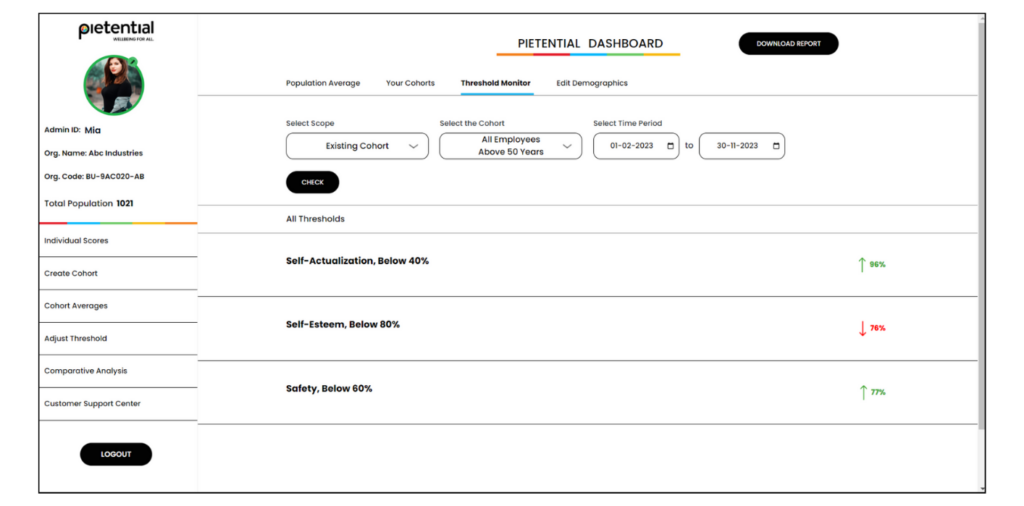
Pietential’s real-time alert system notifies executives of significant drops in wellbeing across the organization. This is particularly useful for DEI&B leaders, who can use these alerts to identify when a particular group is experiencing a dip in their sense of belonging, esteem, or safety.
These notifications enable proactive intervention, that can be continuously fine- tuned to respond to the shifting needs of diverse employee groups.
Building the Case for DEI&B with Data
With Pietential, DEI&B executives can go beyond subjective narratives and build a compelling case for the strategic importance of their work. The platform’s ability to quantify belonging, esteem, and safety within specific demographic groups not only proves the need for DEI&B programs but also enables executives to prove their ongoing impact.
- Demonstrating Program ROI
Organizations increasingly expect DEI&B programs to demonstrate a clear return on investment (ROI). Pietential helps executives do this by linking wellbeing improvements to broader business outcomes such as engagement, performance, and retention. For example, if underrepresented groups report improvements in wellbeing after the implementation of a DEI&B initiative, executives can correlate
this with lower turnover rates, increased productivity, or higher engagement scores.
- Aligning Wellbeing with Organizational KPIs
Traditional organizational KPIs can fail to capture the immediate impacts of DEI&B programs. Wellbeing, on the other hand, acts as a leading indicator, providing executives with real-time data that precedes shifts in engagement and retention. By focusing on wellbeing as a core metric, DEI&B executives can articulate the value of their programs more effectively, showing that improvements in wellbeing
are early signals of broader organizational success.
Proving Efficacy in a Data-Driven World
In the current corporate environment, where data-driven decision-making is paramount, proving the efficacy of DEI&B programs is more critical than ever. Pietential gives DEI&B executives the tools to validate their initiatives through a lens that goes beyond traditional HR metrics. By focusing on the root causes of disengagement, exclusion, and inequity—such as low belonging, esteem, and safety—Pietential enables leaders to not only prove the need for their programs but also substantiate their long-term impact on employee wellbeing and overall organizational health.
Real-World Use Case: Assessing the Impact of a DEI&B Mentorship Program
Consider an organization implementing a mentorship program aimed at
improving belonging and professional development for underrepresented
employees. Pietential can help DEI&B executives track the wellbeing of participants
before, during, and after the program.
- Initial Assessment: Baseline assessments reveal that employees from underrepresented groups report lower scores in belonging and esteem.
- Post-Implementation: After six months of participation, follow-up assessments show a marked improvement in these areas for program participants, compared to a smaller improvement in non-participants.
- Cohort Comparison: Participants in the mentorship program experience a 20% increase in overall wellbeing, while non-participants see a more modest 5% improvement.
- Data-Driven Insight: This data enables the organization to justify the continuation and expansion of the mentorship program, based on its proven ability to improve wellbeing and foster inclusion.
Conclusion
Pietential offers DEI&B executives an unparalleled tool to not only identify the need for diversity, equity, inclusion, and belonging initiatives but also prove their efficacy. By leveraging real-time, data-driven insights into employee wellbeing, DEI&B leaders can build compelling cases for their programs, ensuring ongoing support from stakeholders while continuously refining their strategies to meet the evolving needs of their workforce. In a world where the success of DEI&B programs must be demonstrated through measurable outcomes, Pietential equips leaders with the insights they need to create more inclusive, equitable, and thriving workplaces.